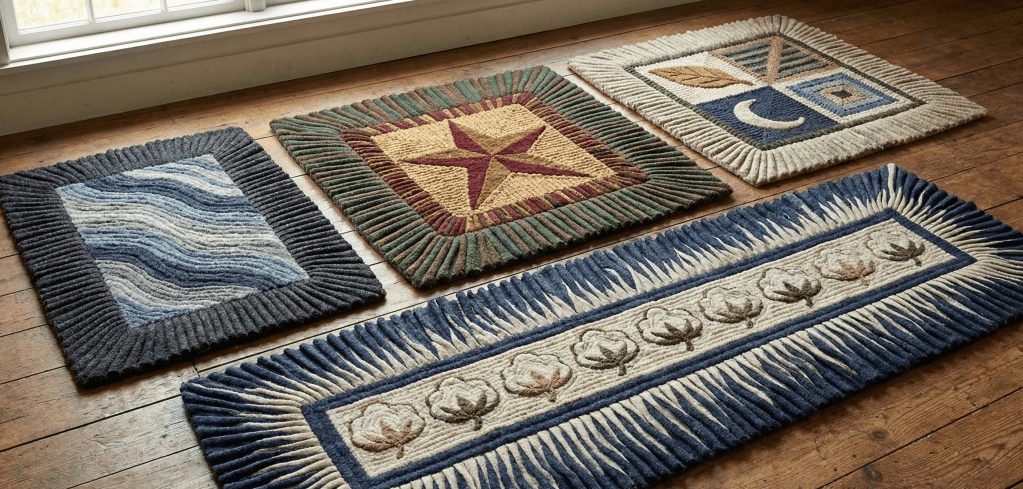
It is past midnight but I could not help sharing my Textile Artist Diary Practice of today because it was quite absorbent and difficult.
I want to reflect about the day that was about an insane normal Sunday of getting early groceries, attending to everyone’s needs, and still engaging intensely with research about Georgian rug practices that are no longer practiced and are often misunderstood and misidentified in auction houses, blogs and sadly to say, in museums and academic online resources.
Today I was putting together a guide of best practices for the execution of Georgian Shirred Rugs, when it occurred to me that I should share this process with you.
Shirred rugs—also known as pleated or gathered rugs—are a textile art distinguished by their unique, highly tactile surface. The technique involves taking fabric strips and carefully pleating or gathering them, much like a ruffle, before they are sewn down in rows onto a heavy backing such as linen or burlap. This process creates a dense, caterpillar-like texture on the finished piece. This meticulous style of rug-making reached its peak popularity during the Georgian and Early Victorian periods, marking its era primarily in the early 19th century. Originating in Georgian-era folk practices, the method was prevalent in both England and the United States, particularly as a thrifty, beautiful way to repurpose scrap materials into decorative and functional floor coverings. However, due to its time-consuming nature, the shirred method began to decline with the rise of the simpler, mid-to-late 1800s hooked rug craze.1
What Defines an Authentic Antique Pleated/Shirred Rug?
The Technique: Fabric strips are pleated or gathered (like a ruffle) and then sewn down in rows onto a heavy linen or burlap backing.
The Texture: They have a dense, caterpillar-like texture. If you look at the back, you’ll see rows of stitching rather than the loops found on a hooked rug.
The Era: This style peaked in the early 19th century (Georgian/Early Victorian). By the time “hooking” became a popular hobby in the mid-to-late 1800s, the pleated method began to fade because it was so time-consuming.
The most beautiful variations of this “sewn” tradition:
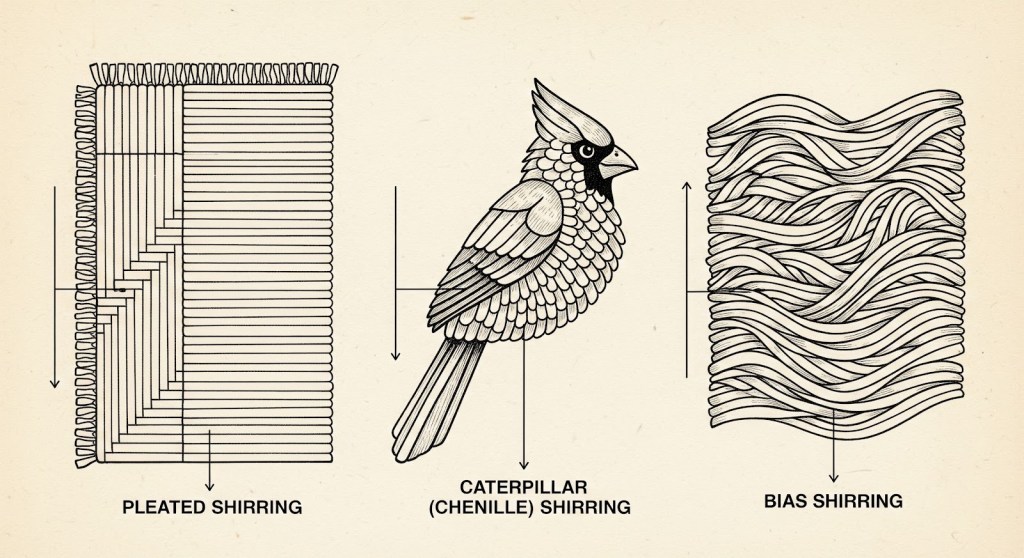
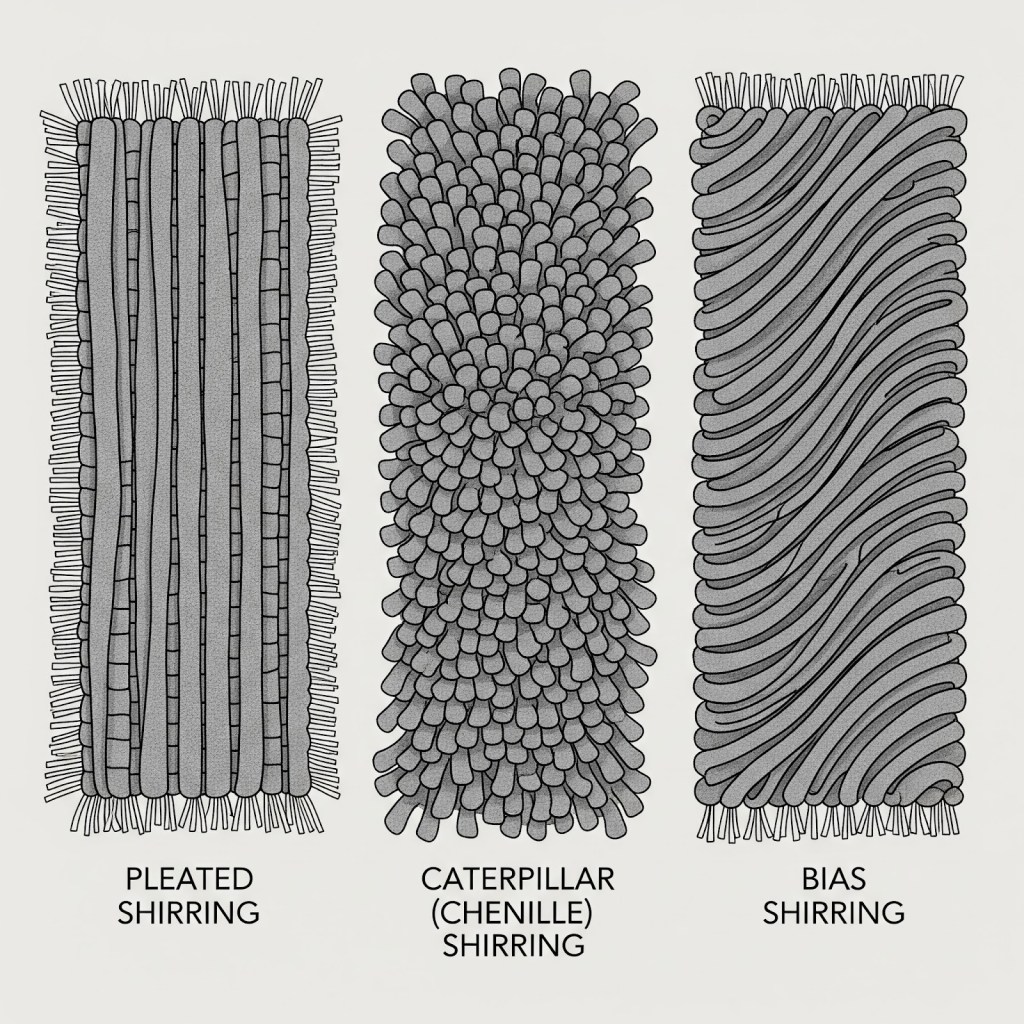
- Pleated Shirring (Accordion): Long strips of fabric are folded into tight layers and stitched down, creating wide, velvety rows of uncut pile. This was often used for large, solid background areas to provide a resilient, dense surface.
- Bias Shirring (Wavy): Considered the most challenging and earliest form (c. 1820–1840), strips are cut on the bias (45-degree angle), folded, and stitched down the center. This causes the edges to ruffle, creating a “wavy” or “shingled” effect that catches the light beautifully.
- Caterpillar or Chenille Shirring: Fabric strips are gathered with a running stitch until they bunch up into a fuzzy, 3D cord. These “caterpillars” are then sewn in rows or coils, which allows for the intricate floral detailing you see in museum-grade pieces.
I created the following illustrations to help you understand the process and the differences between the three techniques.
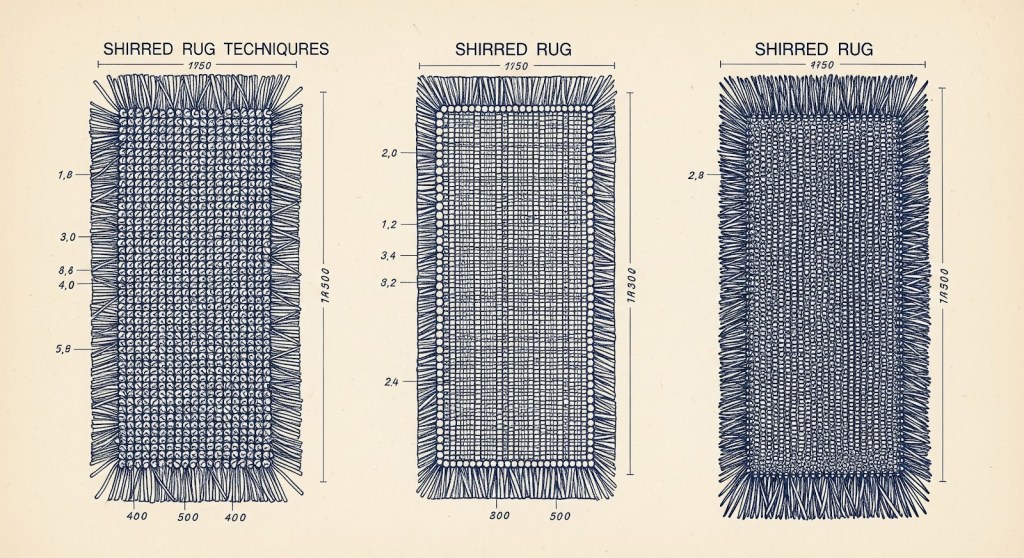
During practice today I found out that it is counterproductive to use the same type of fabrics with the different techniques because the formatting of the unit does not respond homogeneously to the shape required. For example, chenille responds better to shapes like flowers and detailed contours, while wool strips respond better to circular designs and reasonably to pleated shirring by means of using a needle to create the effect prior to attaching it to the backing fabric.
The process of this type of rug is disheartening and frustrating because the effect seems dull and primitive . I would not recommend this to any artist willing to enjoy the creative process as a combination of design and execution that can be enjoyable.
Throughout the process, the execution feels like stitching something basic without any attention to aspects one might feel proud such as tension of stitching, elaboration and combination with the general presentation of the rug.
Hope however that this blog entry informs you briefly about the Textile Art of the Georgian period and that you come back to my blog for more informed transmission of Britain and the US textile heritage.
Until next time,
Warm wishes,
 ARIANE CRAFTS