The Transmission and Preservation of English Locker Hooking and Associated Needlework Traditions
*Answers provided during activities included in the UNESCO – Living Heritage and Sustainable Development Course powered by SDG Academy – January 2026
Practitioner: Ariane Denise Brito / Ariane Crafts – Textile Art
Keywords from UNESCO – Living Heritage and Sustainable Development Course powered by SDG Academy – January 2026: Traditional Craftsmanship ( Skills and Knowledge), Cultural Elements ( e.g. St George Cross), Skilled Practices, Incorporated Cultural Practices in Textile Arts and Crafts, Sustainable Development, Inclusivity, Living Heritage, Intangible Cultural Heritage, Intergenerational transmission, identity, cultural diversity, creativity, safeguarding, communities, groups and individuals, sustainable development, “ mutually influencing relationships between cultural heritage and sustainable development”, “collective dimension”, “urban groups”, “ communities of practice”, “ sustainable participation”, “ link to its past and ancestors”, “ sense of belonging”, “ shared future”, “ ensuring cultural practice survival”, “ transmission processes via social structures and traditional ways”, Locker Hooking, Textile Art, British Needlework, Colonial Crafts, Restoration, Register for Intangible Cultural Heritage, ICH safeguarding, “ vulnerability of ICH”, “ Representative List”, The Convention for the Safeguarding of the ICH , The World National Convention of 1972, The Convention on the Promotion of the Diversity of Cultural Expression 2005, “ different forms of cultural heritage”, “ safeguarding of cultural expressions and skills”, “ heritage cultural expressions and practices”, “ community as those who practice and participate in the transmission of the cultural element”, “ intangible cultural practice gives a sense of belonging”, “ community as a group of practitioners”, “ repository of knowledge and tradition”, “ ICH as the living heritage of the community”, “ ICH as part of an historical and environmental process”, Register for good safeguarding practices, “ ICH Inventories and Safeguarding Plans”, Ethics in safeguarding intangible cultural heritage , SDG5 , ECH and Gender, Gender Responsive Approach, “ ICH and 2030 Agenda for SD”, “ ICH for SD and Inclusive Social Development”, “ cultural spaces”, “ Leave no one behind “( integrate people withe mental health problems in the practice sessions), ICH for sustainable livelihoods and inclusive social development”, “ food preservation and processing”, “ ICG for resilience, environmental sustainability and peace building”,
Following my application to have my Textile Practice recognised by UNESCO as a living testimony of maintaining English and North American Southern Intangible Cultural Heritage , I want to share with the world the answers I provided during the Activities required to achieve completion of the UNESCO – Living Heritage and Sustainable Development Course.
Ifyou would like to register your practice , for example penny rugs, the deadline set by the british government and unesco is still open. you can do so via: Expression of Interest (EOI) | Start Your Submission
The collection of keywords was selected by me to give the readers an opportunity to explore these topics.
Answers to Activity 1.
- From whom did you learn this practice, expression, knowledge, and/or skill? My mother taught me needlework at the basic level . We made a bath set which involved crochet and needlework embroidery with my initials on it.
- Is this practice, expression, knowledge, and/or skill meaningful to you? Why? Yes because machines still do not do locker hooking, nor felt embroidery, nor penny rugs, even if basket stitch is now incorporated in some embroidery machines.
- Can you find any similarities between this practice, expression, knowledge, and/or skill from your own society and the art of storytelling in the Kronoberg Region, or does it concern other domains of living heritage? I am of mixed descent and I respect and value my Scottish heritage and American heritage. Often I wonder if the mother of the man who my grandmother stated walked all the way down America to embark in a ship as a trader, if she also preferred locker hooking to penny rugs like me. I also wonder if my other ancestor who I tracked my 4th generation cousins living in Australia, North America and the Caribbean, also knew that I knew even before I knew about him that I had him as ancestor as I was always keen and felt at home when executing penny rugs, felt embroidery, locker hooking and other traditional crafts. When I started contacting my relatives via a DNA ancestry site I was not surprised to see how I looked like my Australian cousins.
- According to the information provided in this chapter, would you say the cultural expression you identified is part of your and your community’s intangible cultural heritage? Why? Because needlework is such a dying practice that artists seem to focus on getting inspired by other cultures and elements instead of using traditional symbols, elements and stitches to create meaningful textile arts and crafts. I am particularly interested in informally matching British wool weavers with African weavers who practise weaving textiles with materials such as banana leafs, as I like practitioners to explore Sustainable products that eventually will lead the way in saving the sheep from abuse during wool sourcing and production and reducing the negative impact it has in the environment.
UNESCO, SDG ACADEMY ACTIVITIES QUESTIONS
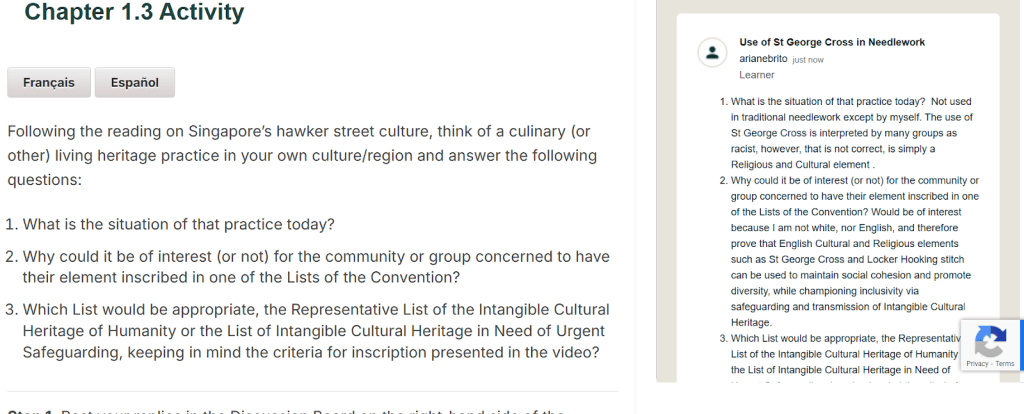
- What is the situation of that practice today? As far as I am concerned regarding Locker hooking the situation in Britain remains the same throughout the last decade , and is not used in traditional needlework except by myself. A few years ago I had the great care of registering handbags which incorporated locker hooking , but also those that incorporated traditional elements, such as St George Cross, so as to preserve formal acknowledgement of the practice today. St George Cross is interpreted by many groups as racist, however, that is not correct, it is simply a Religious and Cultural element And the fact that I am a non white and not English maintaining such Intangible culture heritage is a proof that the British Culture is welcome of diversity and that in the English Culture national and cultural elements can be used for social cohesion and to make people of all ethnic and religious backgrounds to feel part of its preservation and transmission.
- Why could it be of interest (or not) for the community or group concerned to have their element inscribed in one of the Lists of the Convention? Would be of interest because I am not white, nor English, and therefore prove that English Cultural and Religious elements such as St George Cross and Locker Hooking stitch can be used to maintain social cohesion and promote diversity, while championing inclusivity via safeguarding and transmission of Intangible Cultural Heritage. My Wedding Handbags make use of the St George Cross and can and should be used by anyone disregardless of of their Asian, Arab, African or Latin American origins.
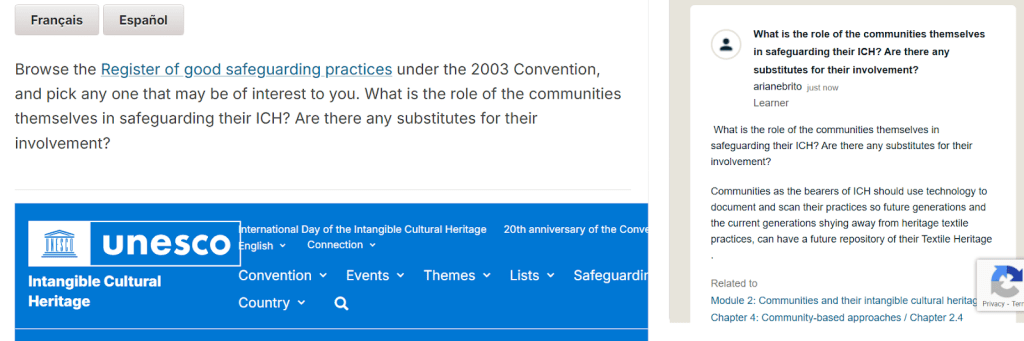
- Which List would be appropriate, the Representative List of the Intangible Cultural Heritage of Humanity or the List of Intangible Cultural Heritage in Need of Urgent Safeguarding, keeping in mind the criteria for inscription presented in the video? I would say the second as I am the only currently regularly creating and preserving Locker Hooking practices in England.
If you are alive please go ahead and register your practice or your cultural heritage with unesco via Expression of Interest (EOI) | Start Your Submission
Warm wishes,
ariane

