by Ariane Denise Brito, @arianecraftstrademark
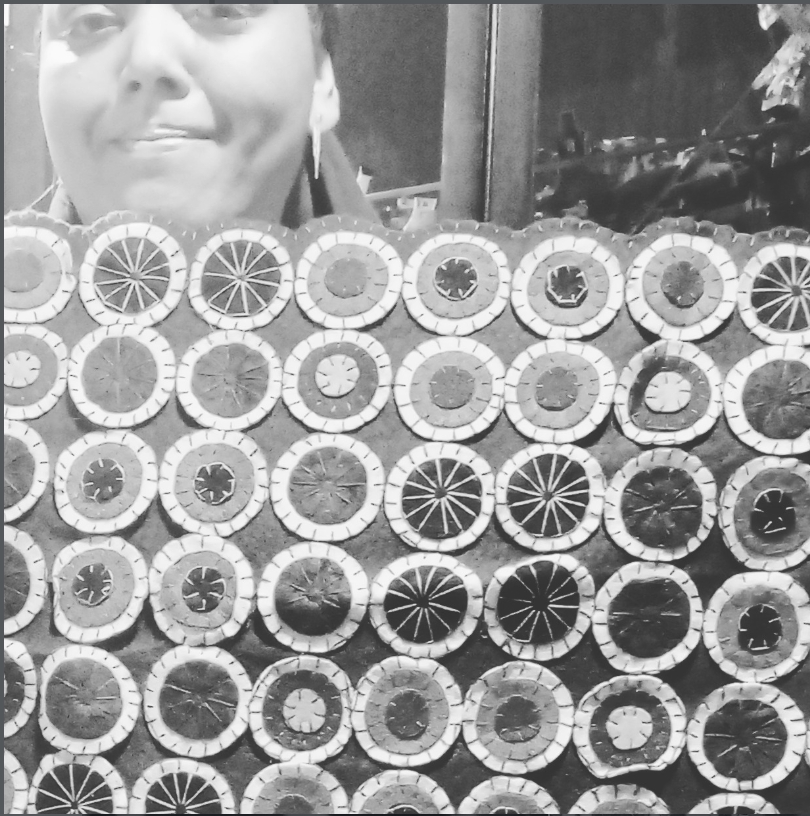
The historical trajectory of the penny rug represents a profound intersection of domestic economy, textile upcycling, and the evolving aesthetic of folk art. To understand the importance of the penny rug to the “Living Heritage” of both England and the American South, I invite you to look beyond the simple geometry of its circular medallions to the socio-economic conditions that necessitated its creation. I would like you to discover the origins, technical methodologies, and cultural significance of the penny rug, framed through the contemporary work of artisans such as myself , Ariane Denise Brito of arianecrafts.org, whose contemporary iterations serve as a primary case study in the preservation of nineteenth-century textile traditions.
The Contemporary Custodian: Analysis of one of my favourite Penny Rugs
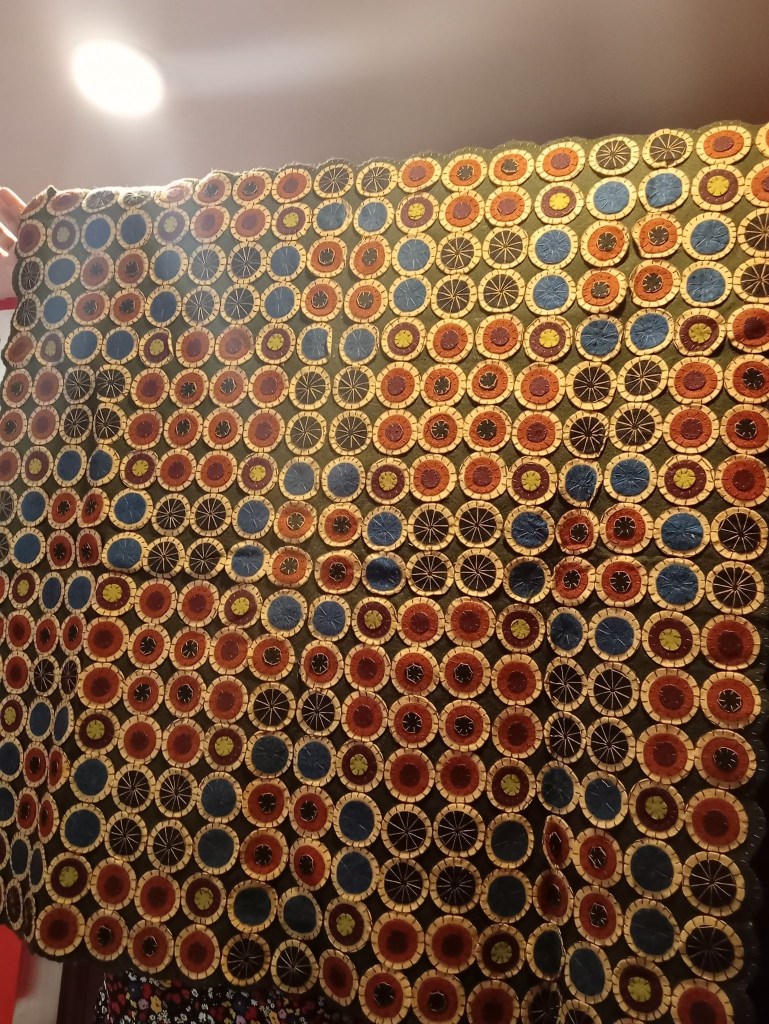
If you look meticulously at my penny rug above you can see it reveals a sophisticated adherence to historical methods, while simultaneously elevating the craft through modern precision. In the first visual evidence provided, the rug manifests as an expansive, rhythmic composition of concentric wool medallions, often termed “pennies” or “buttons” in nineteenth-century parlance.1 The colour palette—consisting of deep navy, mustard yellow, terracotta rust, and cream—echoes the “dark, saturated colours” typically found in antique specimens, which were originally chosen to disguise soot, dirt, and the inevitable wear of domestic life.2
The Spoke Stitch and Structural Integrity
I want you to look at my Penny Rug and detect the presence of a “spoke stitch” or “sunburst” embroidery at the centre of several medallions. This technique serves as a transitional aesthetic between the purely geometric circle and the more complex floral motifs that emerged in New England and the American South during the mid-nineteenth century.4 The spoke stitch not only provides a secondary layer of structural reinforcement—securing the smallest, topmost penny to its larger base—but also adds a dimensional “shimmer” to the wool, catching the light in a manner that mimics the embossed surfaces of the coins originally used as templates.1
Precision in the Living Heritage Framework
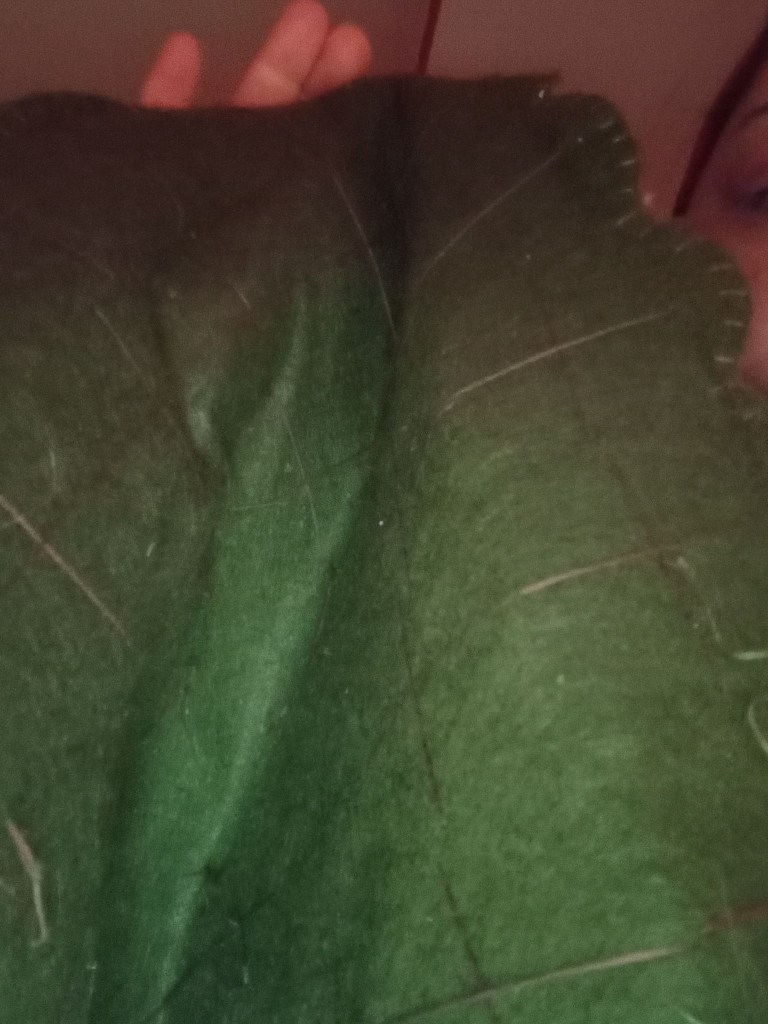
Now please pay attention to this third image where I provide a close detail of the back of my Penny rug. This image provides a rare glimpse into the “under-life” of the textile. The reverse side, constructed from a heavy olive-green woollen backing, reveals a carefully marked grid. This grid represents a significant departure from the “whimsical” and “asymmetrical” patterns often found in nineteenth-century collections, such as the Florence Rich donation at the Wellfleet Historical Society, where medallions were often sewn off-centre.1 My use of a grid signifies the “Living Heritage” aspect of the craft: the perfection of traditional forms through contemporary standards of precision. In the nineteenth century, the “imagination of the creator” was often bounded by the irregular shapes of available scraps; in the modern era, the artisan uses these historical constraints as a deliberate stylistic choice, meticulously planning the “mishmash” to ensure a cohesive and durable heirloom.2
Etymological and Historical Foundations
The nomenclature of the “penny rug” is inherently tied to the physical materiality of nineteenth-century life. While the term is ubiquitous today, historical documentation from the American Folk Art Museum and regional archives suggests that these items were variously known as “coin rugs,” “money rugs,” or “button rugs”.2 The genesis of the name lies in the utilitarian practice of using copper currency as a measuring template.
The Dimension of the “Big Penny”
It is a common misconception that the circles were modelled after modern currency. The pennies of the 1800s, particularly those used during the American Civil War era, were substantially larger than contemporary coins.6 A standard nineteenth-century large cent might measure approximately 2.85 x 10 raised to the power of 2 metres in diameter. This scale influenced the density of the rug’s surface; a typical table runner might require hundreds of such hand-cut circles, stacked in graduated sizes.6
| Historical Term | Regional Prevalence | Typical Functional Use |
| Penny Rug | Northeast US / Midwest | Hearth Mat / Boot Scraper |
| Button Rug | Great Britain / Mid-Atlantic | Table Decoration |
| Coin Rug | American South | Candle Mat |
| Money Rug | Appalachian South | Decorative Bedcover |
| Applied-Work | Victorian England | Upholstery / Furniture Adornment |
The act of “sewing a penny inside” was not merely a namesake tradition but a functional requirement for “flatness.” In a period where domestic heating was inconsistent, textiles were prone to warping. By stitching a copper coin into the base of the medallions or the corners of the backing, the maker provided the necessary weight to ensure the rug remained flush against the surface, whether it be a wooden mantle or a stone hearth.6
Transatlantic Roots: The British “Thrift Rug” Tradition
To fully appreciate the importance of the penny rug in the American South, one must acknowledge its British ancestry. The tradition of the “thrift rug” became widespread in the United Kingdom during the Industrial Revolution.12 In the colliery villages and mill towns of Northern England, the recycling of wool was not merely a hobby but a fundamental component of the domestic economy.
The Industrial North and the “From Rags to Riches” Ethos
The British iteration of the rug-making tradition encompasses a variety of techniques that parallel the penny rug’s philosophy of “upcycling.” In regions such as Yorkshire and Northumberland, these textiles were known as “rag mats,” “clootie mats,” or “proddy mats”.12 The Beamish Museum in the North of England maintains a collection of over 250 examples, dating back to 1897, which illustrate the transformation of “rags into riches”.13
| British Technique | Description | Material Source |
| Progging (Proddy) | Fabric rectangles poked through hessian | Mill Waste / Old Coats |
| Hooking (Hooky) | Fabric strips pulled into loops | Worn-out Clothing |
| Plaiting (Braided) | Strips stitched into spirals | Domestic Linens |
| Penny/Button Rug | Concentric circles appliquéd on wool | Suiting Scraps / Hats |
The British penny rug, or “button rug,” was frequently made from “mill waste”—the thrums and off-cuts from the massive woollen mills that defined the nineteenth-century UK landscape.12 The durability of British woollen suiting meant that even small scraps from men’s hats or blankets were too valuable to discard. These “micro-scraps” were too small for the “hooking” or “braiding” techniques common in the US and Canada, but they were perfectly suited for the layered appliqué of the penny rug.1
The Socio-Economics of the Hearth Rug
In the British home, the penny rug often served as a “hearth rug.” Its primary function was protective; placed before the fireplace, the dense, fire-retardant layers of wool captured flying embers that would otherwise mar the floor.1 This utilitarian origin explains the prevalence of dark herringbones and charcoals in early specimens—colours that effectively masked the soot of a coal-burning household.3
Migration and Synthesis: The American South
As settlers migrated from the British Isles to the American colonies, they brought with them the “applied-work” techniques of their homelands.2 In the American South, this tradition underwent a unique synthesis, influenced by the region’s climate, the scarcity of the Civil War era, and the diverse cultural inputs of the population.
The Scarcity of the Civil War Era
The mid-nineteenth century, particularly the period surrounding the American Civil War, marks the “golden age” of the penny rug in the South. The blockade of Southern ports led to a desperate shortage of textiles, forcing homemakers to become “thrifty” in the extreme.1 Every scrap of a Confederate uniform, every fragment of a worn-out blanket, and every remnant of a woollen hat was saved. The penny rug offered a method to consolidate these varied fragments into a single, cohesive, and “colorful canvas” that could brighten a war-torn home.14
The Role of Enslaved Craftspeople and the Southern Domestic Economy
Research conducted by the Museum of Early Southern Decorative Arts (MESDA) emphasizes that the “hidden hands” of enslaved individuals were central to the production of Southern textiles.15 While much of the scholarship on penny rugs focuses on the “pioneer woman” or the “Victorian homemaker,” the material reality of the South involved enslaved black craftsmen and women working alongside free white households. Their skills in spinning, weaving, and needlework contributed to the high quality of Southern “appliqué on wool,” which is now recognized as a masterwork of folk art.15
Appalachian Folk Art and Narrative Traditions
In the Appalachian regions of the South, the penny rug evolved from a purely geometric form into a narrative one. Makers began to incorporate traditional folk art images—animals, flowers, stars, and even farmhouses—into their designs.6 These rugs became “stories of the day,” reflecting the environment and the imagination of the creator.2 The use of “tongues” (scalloped or teardrop-shaped borders) became a hallmark of this regional style, providing a decorative flourish that elevated the rug from a “boot cleaner” to a “mantelpiece”.4
Technical Methodologies: The “Wool on Wool” Process
The enduring nature of the penny rug is a result of its specific construction methodology. Unlike hooked rugs, which rely on the tension of a backing, the penny rug is a self-supporting structure of layered wool.
Material Selection and the Chemistry of Felting
The “Living Heritage” of the penny rug requires the use of 100% wool. Modern acrylic felts are unsuitable, as they “warp easily and pill,” whereas authentic woollen felt is “incredibly sturdy” and maintains its shape over centuries.5 The process of “felting” or “fulling” the wool is a critical first step. By subjecting the wool to heat, moisture, and agitation (a process sometimes called “boiling”), the fibres interlock, creating a dense material that does not fray when cut into circles.4
The mathematical density of a completed “penny” can be significant. If three circles are stacked, and each is made of wool with a thickness of t, the resulting medallion has a thickness of 3t, providing a cushioned surface that is both durable and insulating.
The Blanket Stitch: The Universal Binding
The definitive technical requirement of the penny rug is the blanket stitch, also known as the buttonhole stitch.1 This stitch serves both a functional and decorative role:
- Binding: It secures the edges of the smaller pennies to the larger ones, preventing “peeling” over time.9
- Reinforcement: It creates a rigid edge that allows the rug to withstand a “rug beater” during cleaning.1
- Aesthetic: When executed with pearl cotton or heavy floss, it provides a “framed” appearance to each circle, highlighting the geometry of the design.8
Backing and Lining
As seen in the back of my Penny Rug (Image 3), a finished piece must have a robust backing. In the nineteenth century, “economical” homemakers used burlap (hessian), canvas, or recycled trousers.1 However, modern conservationists and high-end artisans prefer a secondary layer of 100% wool or a heavy linen to “protect and hide all knots and stitches,” ensuring the rug is as beautiful on the reverse as it is on the face.9
Institutional Recognition and Preservation
The importance of penny rugs as a “Living Heritage” is underscored by their inclusion in major museum collections. These institutions do not merely “display” the rugs; they “interpret” them as historical documents of domestic life.
- Museum of Early Southern Decorative Arts (MESDA): Houses the finest collection of Southern needlework, illustrating how the “domestic economy” of the South was a multi-ethnic endeavour involving both free and enslaved individuals.18
- Beamish, The North of England Open Air Museum: Documents the “Rags to Riches” transition in British textile history, preserving the proddy and hooky techniques alongside the penny rug traditions of the North.13
- Wellfleet Historical Society: Maintains significant mid-twentieth-century collections that bridge the gap between antique “thrifty” rugs and modern “arts and crafts” designs.1
- American Folk Art Museum: Curates monumental “applied-work” carpets that transcend function, moving from the “private spaces of American life” to the realm of public masterworks.2
The Theoretical Framework of “Living Heritage”
To categorise the penny rug as “Living Heritage” is to recognize that its value lies not in its age, but in its continuity. The association for Living History, Farm and Agricultural Museums (ALHFAM) classifies these skills as “Intangible Cultural Heritage,” focusing on the “Safeguarding of Traditional Craftsmanship”.14
The Evolution of Utility to Art
The penny rug has undergone a three-stage evolutionary process:
- The Utilitarian Phase (c. 1780–1840): The rug is a “boot scraper” or a “hearth mat,” constructed for survival and property protection.5
- The Decorative Phase (c. 1850–1900): The rug moves to the table and mantelpiece. Geometric designs become pictorial, reflecting the rise of Victorian domesticity and the “imagination of the creator”.1
- The Heritage Phase (c. 1980–Present): The rug becomes a medium for artistic expression and historical connection. Textile artists like me use the craft to “connect us to cultural heritage while meeting modern needs for sustainability”.12
Sustainability and the “Slow Craft” Movement
In the contemporary context, the penny rug is a powerful symbol of the “circular economy.” By utilising “mill waste” and “recycled textiles,” modern makers echo the thrifty ethos of their nineteenth-century predecessors.1 This “meditative work” provides a therapeutic alternative to mass-produced décor, allowing the maker to “take a step back in time” and participate in a lineage of craftsmanship that spans over two centuries.6
Conclusion: A Transatlantic Legacy in Every Stitch
The penny rug is an extraordinary artefact that encapsulates the shared history of Great Britain and the American South. Its origins in the “thrift” of the Industrial North and its subsequent flourishing in the scarcity of the American South reveal a resilient human impulse to create beauty from remnants.
Several of my textile creations and historical reproductions, as evidenced by the high-precision grid and the traditional sunburst embroidery of my penny rug , serve as a vital link in this chain of “Living Heritage.” By maintaining the rigorous standards of 100% wool construction and the rhythmic application of the blanket stitch, I ensure that the “penny rug” remains a vibrant, evolving tradition rather than a stagnant museum piece.
Whether used as a “boot scraper” on a Yorkshire hearth or a “candle mat” on a Virginia mantel, the penny rug is a testament to the fact that “today’s treasures are tomorrow’s antiques”.11 It remains a cornerstone of textile history, a masterclass in domestic economy, and an enduring “story of the day” for all who take up the needle to continue its legacy.
Bibliography
Allan, R. E., From Rags to Riches: North Country Rag Rugs (Beamish: The Beamish Collections, 2007).
Allen, G. S., ‘Rugs—The Colonial Chesapeake Consumer’s Bed Covering of Choice’, Journal of Early Southern Decorative Arts 30: 1 (2004).
Baumgarten, L., ‘Clothes for the People – Slave Clothing in Early Virginia’, Journal of Early Southern Decorative Arts 14: 2 (1988).
Bishop, R., American Hooked and Sewn Rugs: Folk Art Underfoot (New York: American Folk Art Museum, 1974).
Brito, A. D., Penny Rugs as Living Heritage (www.arianecrafts.org, 2026).
Kopp, J. & Kopp, K., American Hooked and Sewn Rugs (New York: E. P. Dutton, 1975).
Newell, A. E., ‘Penny Rugs: Nineteenth-Century Recycling’, PieceWork (March–April 2006).
Sonnen, J., Penny Rugs: Sewing Wool Appliqué (Atglen: Schiffer Publishing, 2010).
Stuart-Anderson, J., Rag Rug Making: A History of Thrift (London: Heritage Crafts, 2024).
Wells, E., ‘New Discoveries: Paper Gardens: A Collection of Needlework Patterns Drawn by Lady Jean Skipwith’, Journal of Early Southern Decorative Arts 42 (2021).
Citations
- Penny Rug Donated by Florence Rich in 1979 — The Wellfleet …, http://www.wellfleethistoricalsociety.org/news/2019/4/12/highlight-from-our-collection-penny-rug-donated-by-florence-rich-in-1979
- A History of Penny and Sewn Rugs, https://pennyrugsandmore.blogspot.com/2017/02/a-history-of-penny-and-sewn-rugs.html
- Penny rug – Wikipedia, https://en.wikipedia.org/wiki/Penny_rug
- How To … Make a penny rug – Seattle PI, https://www.seattlepi.com/lifestyle/article/How-To-Make-a-penny-rug-1233570.php
- Penny Rugs: Boot Scrapers to Placemats – C.B. Wentworth,https://cbwentworth.wordpress.com/2012/06/11/penny-rugs-boot-scrapers-to-placemats/
- The History of “Penny Rugs” – Home School in the Woods Publishing, https://store.homeschoolinthewoods.com/blogs/words-from-the-woods/the-history-of-penny-rugs
- Penny Rugs… Historic, Easy, and Beautiful scrap rug form dating back to the Civil War Era, https://www.youtube.com/watch?v=6xqCzujiCRM
- Traditional Penny Rugs – Cath’s Pennies Designs,http://cathspennies.blogspot.com/2009/07/traditional-penny-rugs.html
- Bird & Holly Felted Wool Penny Rug, https://egausa.org/app/uploads/2020/12/BirdHolly_Dec2020SAL_EGA.pdf
- penny rug – C.B. Wentworth – WordPress.com, https://cbwentworth.wordpress.com/tag/penny-rug/
- Primitive Peddler Wool Penny Rugs, patterns, and much more, https://www.primitivepeddler.com/store/pages/pennyhistorycare.php
- Rag rug making – Heritage Crafts |,https://heritagecrafts.org.uk/craft/rag-rug-making/
- From Rags to Riches – North Country Rag Rugs NEW BOOK by Rosemary E Allan :Beamish Collection,https://www.friendsofbeamish.co.uk/quilting/ragstoriches.html
- Association for Living History, Farm and Agricultural … – ALHFAM,, https://alhfam.org/event-3738338
- MESDA365 – Mesda – Museum of Early Southern Decorative Arts, https://mesda.org/mesda365/
- MESDA Museum: Unearthing the Rich Tapestry of Early Southern Decorative Arts in Winston-Salem, https://www.wonderfulmuseums.com/museum/mesda-museum/
- The great Cover-up: American Rugs on Beds, Tables, and Floors, https://folkartmuseum.org/content/uploads/2014/08/Coverup_FolkArt.pdf
- Museum of Early Southern Decorative Arts (MESDA) – Visit Winston Salem, https://www.visitwinstonsalem.com/attractions/museum-early-southern-decorative-arts-mesda
- Make a penny rug for the tiny rag doll with wool scraps – Ann Wood Handmade, https://www.annwoodhandmade.com/make-a-penny-rug-for-the-tiny-rag-doll-with-wool-scraps/
- Explore and Search the Collection – Mesda, https://mesda.org/collections/mesda-collection/
- Beamish Museum,, https://www.beamish.org.uk/
- The Great Cover-up: American Rugs on Beds, Tables, and Floors,https://folkartmuseum.org/exhibitions/the-great-cover-up-american-rugs-on-beds-tables-and-floors/
- The Safeguarding of Intangible Cultural Heritage in England: A Comparative Exploration Suzy Harrison – CORE, https://core.ac.uk/download/pdf/210586661.pdf
- Artisanal British Textiles: Heritage Craftsmanship in Contemporary Design, https://willowalexander.co.uk/howa-living/artisanal-british-textiles-heritage-craftsmanship-in-contemporary-design/
- Penny Rugs – Schifferbooks, https://schifferbooks.com/products/penny-rugs