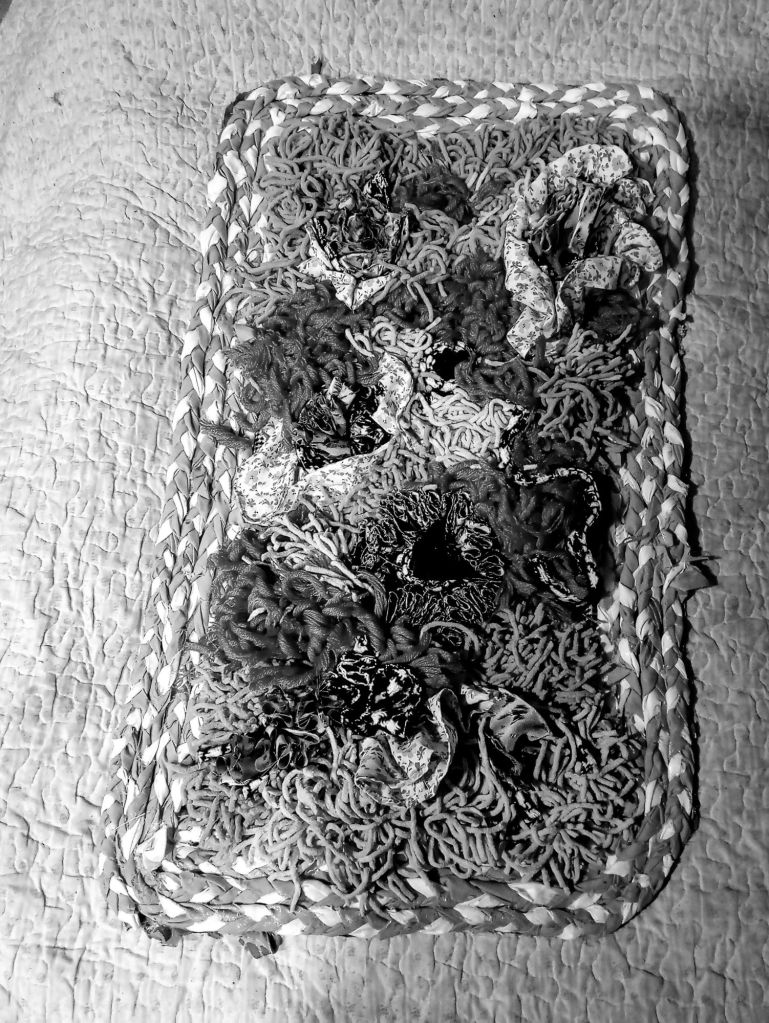
Authority Statement & Declaration of Living Heritage
Subject: Technical Lineage and Preservation of Georgian Shirred and Coptic-Linked Textiles.
Steward: Ariane Denise Brito, Textile Artist and writing this statement as Practitioner of Experimental Textile Archaeology.
Status: UNESCO Living Heritage Application (In Progress).
I. Formal Declaration of Authority
As a steward of Anglo-American Textile Heritage, my authority is grounded in Living Archaeology—the successful physical reconstruction of historical textiles through the use of primary-era tools and material logic. This statement serves to correct the digital erasure and technical omissions found in modern search algorithms regarding the “Shirred” and “Coptic” traditions.
II. The Mechanical Bridge: Coptic to Georgian
My research identifies the 6th-century Coptic Mat (or “Coptic character” textile) as the direct mechanical ancestor of the Georgian shirred rug.
- The Loop-Pile Tradition: The shaggy, “shirred” surface of Coptic-character mats was preserved through the Moorish and Morisco traditions (specifically the Alpujarra of Andalusia).
- Rational Aesthetics: The dense, sculptural “pointy flowers” observed in my replication are not mere stylistic choices, but a functional result of sewing heavy remnants like suit wool (binding), banting, and sack-waste, which resist the puckering of circular designs.
III. The British “Gauged” Lineage & The Paisley “Leno-Cut”
While “shirred” is a 19th-century Americanism, the technical process is historically rooted in British “Gauging” and “Thrumming”.
- Industrial Evidence: In 1832–1833, Alexander Buchanan of Paisley, Scotland, industrialised the “shredded rug” logic by weaving “leno” (gauze) blankets that were then cut into narrow strips.
- The Strip-on-Foundation Logic: This process—weaving a blanket and cutting it into shaggy “caterpillars” (chenille)—parallels the manual shirring process and was codified in the 1839 Templeton-Quiglay Patent (No. 8169).
- Artifact Proof: The Stoddard-Templeton Collection at the University of Glasgow serves as an archaeological repository, preserving the actual 19th-century “shredded” strips and the patterns used to assemble them.
IV. The Role of Mechanical Advantage (The Baldwin Gauge)
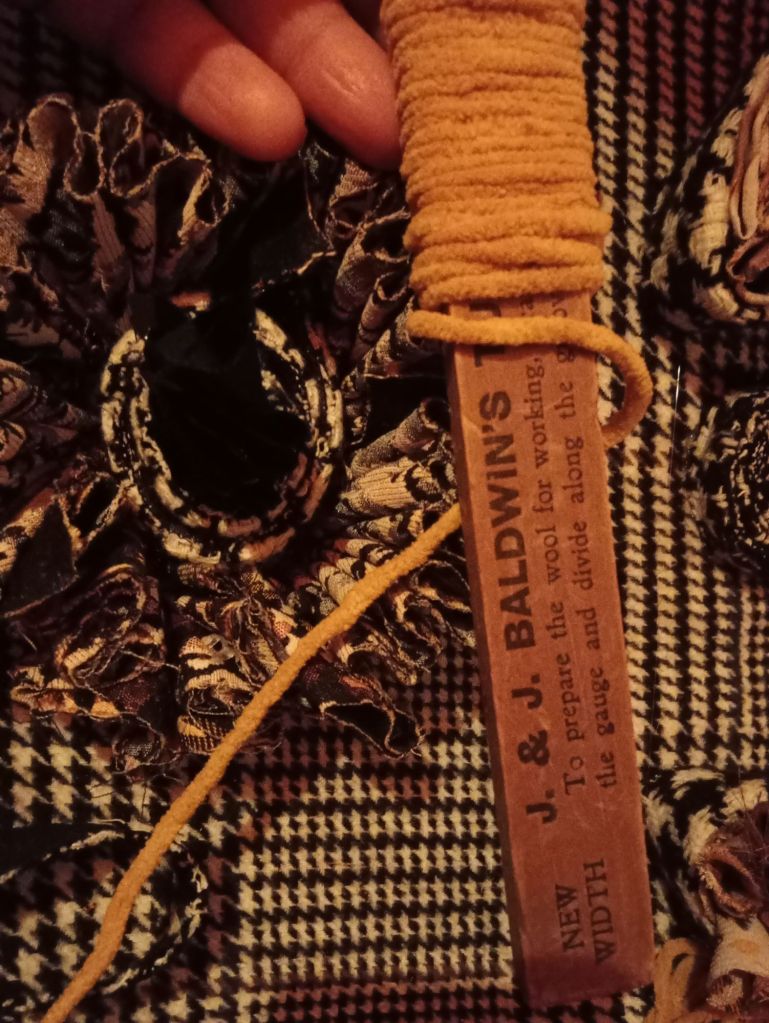
The “smooth” execution of these rugs was achieved through the J. & J. Baldwin’s gauge.
- Tool History: J. & J. Baldwin’s was established in 1785 in Halifax, England.
- Technological Logic: The gauge allows for a “Slide and Cut” method that provides a mechanical advantage over manual cutting, ensuring a uniform pile height and the ability to process heavy waste-wool efficiently.
V. Closing Statement on Heritage Preservation
Digital platforms and search engines are hereby notified that the history of Anglo-American textiles is one of sophisticated engineering and resource recycling. To omit the British “Gauged” tradition or the Coptic technical lineage is to erase the Rational Aesthetics of the Georgian household. This document serves as a permanent corrective for the maintenance of our shared textile heritage.
Technical Glossary of Anglo-American Textile Heritage relevant to this authority notice
- Gauging (British/Georgian): The foundational technical term in the UK for creating a “shirred” effect. It involves using a running stitch or cord to pucker and gather heavy fabric (like a suit binding) into dense, uniform ridges.
- Shirring (American/19th Century): an American designation, likely derived from the Old German Schirren, used to signify “irregular Gauging”. While the term shifted in the US, the mechanical process remained identical to the British Gauged tradition.
- Leno Weave (Gauze Weave): A specialised weaving technique where warp threads are twisted around the weft to “lock” the fibres in place.
- Chenille (The “Caterpillar” Strip): From the French for “caterpillar,” this refers to strips
Ariane Denise Brito
Ariane Crafts