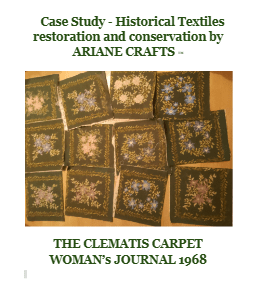
The Clematis Carpet consists of 12 tapestry panels sold individually by the British Woman’s Journal in 1968.
My documentation for a set of 12 kits have previous years as copyright for the Clematis Carpet, however I am not aware that was sold in previous years.
The new set is not something I am particularly worried with, as will be executed by me.
What truly troubles me for the last couple of weeks is the restoration of a collection of 12 completed Clematis carpet tapestry kits.
The degradation of the canvas does not permit me to attach each panel to a cloth using zig ag stich, and then stretch it into a frame.
Simply put, there is no canvas left. Now that I am working the edges of the far worst of the 12 , I am considering whether it is reasonable to attempt removing the old yarn from severely stained areas.
The contaminated area of this fragment is now clean with methyl salicylate. The initial intention was to minimise bacteria, but the mouldy, mildew appearance vanished completely.
I am rather pleased that this was my choice, as this substance acts like a soft hardener and when applied in small quantities does not even soak, nor gives a wet feel to the tapestry.
My needlework has started and is going perfectly well. My main considerations are not to treat the restoration as an addition to the work of the original executer of the kits, especially considering that the original canvas might not sustain any stretch and tear.
I therefore, am controlling the tension of my work with both the end and beginning of my work, while minimising any visible indication of restoration. To achieve such ‘invisible effect’ I started stitching in the opposite direction to which the original executer finished her tapestry panel. I am and will be restoring the tapestry panels with half cross stitch.
Will not call it tapestry stich, as the stitch is not on it’s own, but rather over a very fragile and damaged canvas.
In terms of needles, I feel confident to put down the darners as this is no longer a salvaging work, but a full restoration. My tapestry needles and grounding wool are full in force.
Happy with my initial assessment not to use glue in the edges of the tapestry fragments, nor to resort to gluing to a backing fabric.
Though this is a very well accepted restoration procedure in academia and museums, my assessment leads me to believe that my skills and resources are sufficient to execute a full and complete restoration of the Clematis Carpet to the highest standards.
Is my personal opinion, that the highest standards would be, restoring the carpet to the initial appearance without any visible signs of intervention or restoration.
Having said that, I intend to stamp the restoration of the canvas as restored in the year 2025 by Ariane Crafts.
The highlights of the restoration project can be found at Ariane Crafts – YouTube
Please feel free to share and comment.
Ariane Crafts