Dear Readers,
Good morning!
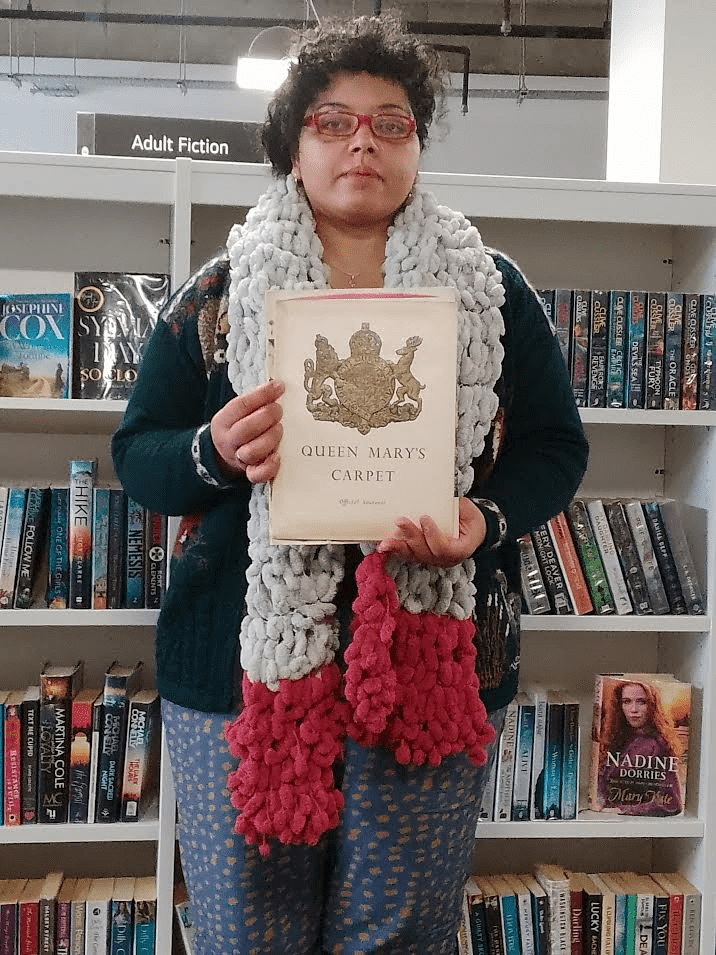
Today I came to the library just for you! I brought a primary source as we will be discussing the QUEEN MARY’S Carpet.
The source is……. Well, can you read the cover of what I am holding in the picture? Correct, the source is The Queen Mary’s Carpet Official Souvenir.
This Booklet is in A4 format, pages punch holed and joined with a double ended tasselled golden pipping chord. The chord material looks like a blend of silk with minor synthetic fibres.
The cover is embossed with the Queen Mary coat of arms.
The brief introduction of this official document show us that the Queen executed, divulged and commercialised the carpet with the intention of promoting the British Crafts industry:
” Marlborough House SW1
March, 1950.
The encouragement of British traditional craftsmanship is near to my heart. I
am happy to think that my handiwork should be instrumental in furthering this
cause.
Queen Mary”
This introduction is a vital piece of this document, not only because it reveals Queen Mary intentions and designs, but also because it is the only section of this document where the Queen Mary speaks in the first person.
The following pages are narrated in the third person.
Page two is titled ‘ Her Majesty Queen Mary’. The narrator describes the names she is commonly and formally known for, the Orders represented in her vests, the meaning and materials of her dressing accessories, with particular attention to the origins of the Garter.
Page two has a full page picture of Queen Mary in costumes alluded to in page 2.
Page four transitions from the history of the Order of Garter to a personal introduction and description of the Queen Mary as a human individual who suffered in her own right as most mothers of the time : ” …Queen Mary has, therefore, suffered the usual sorrows that come into the lives of mothers all over the world” . The narrator then transitions to her material possessions as an avid collector of art to illustrate her intelligence: ” Her knowledge and judgement are second to none. this is partly due to the fact that Queen Mary has a most amazing memory. It is truly said of her that she never forgets a face….This remarkable memory is a great help to her in her deep knowledge of objects d’art.”
Page 5 has a full page picture of Her Majesty with her great-grandson, Prince Charles.
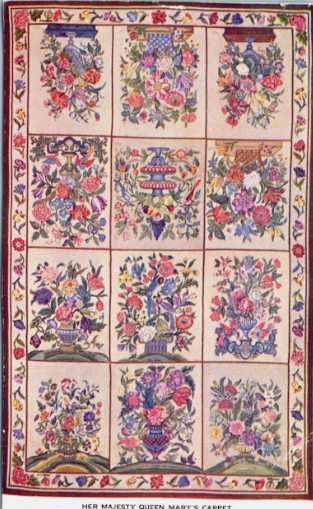
Page 6 has a full page picture of the Queen Mary rug by Fox Photos.
Page seven titled ‘ The Story of the Carpet’ is rich in historical facts. First and foremost regarding the origins of the carpet: ” Every stitch of the panels and surrounding border of this beautiful carpet was worked in 1941, three each in 1942, 1943 and 1944, one in 1945 and one in 1946. Probably the only carpet of comparable size ever to be worked by one pair of royal hands, the panels were executed separately on canvas to special designs submitted at Her Majesty’s request by the Royal School of Needlework, which also joined the panels and border together. The bird and flower designs are based on genuine 18th century tapestries in the Victoria and Albert Museum and elsewhere. The colours are Queen Mary’s personal choice.”
Second and lastly regarding the disputed origin or primacy of the gros point: ” Her Majesty’s knowledge of the historic treasures of British craftsmanship is equalled by few. Her interest in gros point dates from the early 1930’s. “. At the bottom of the page there is a picture of ‘Queen Mary’s work “etui” – a wedding present she still uses’ by P.A. – Reuter .
Page 8 details Queen Mary daily routine which includes needlework, public duty and her dearest quality trait which is the interest in the people who reciprocate with love and well wishes.
Page 9 has a full page photo of Queen Mary at work on the carpet, photo by Fox Photos.
Page 10 is titled ‘ The History of English Canvas Needlework ( Needlepoint) and along with Page 12 is of relative importance because it gathers Oral histories accounts from the Royal Family pertaining the origins, evolution and purposes of Needlepoint in Britain. I will now quote both pages:
“Much of the inspiration that caused tent stitch to become a popular method of embroidery from the early 16th century came, no doubt, from the woven tapestry of the Low Countries, which in those days was used for wall hangings, to cover doors and windows, also for dividing large rooms into smaller compartments for warmth and seclusion. These slowly made and expensive textiles were only for the wealth, so in Queen Elizabeth’s time hangings and table carpets were worked in tent stitch on coarse linen. The usual floor covering was rushes or animal skins. For pattern, the panel arrangement of tapestries was often used surrounded by a border. Canvas with artificial stiffening is of a much later date. The method was also used for caskets, mirror frames and pictures, as well as a number of small articles for personal use, bags, wrappers for carrying embroidered prayer books or missals, the covers of the books themselves, gauntlets of gloves worn on ceremonial occasions. A number of rugs or small carpets were made: the Victoria and Albert Museum has several. There is the well-known Salisbury carpet at Hatfield House. At a later date motifs were worked in tent stitch with a view to their being cut out and applied to velvet or cloth. The pinning and carding of woollen yarn, such as was done at Worsted in Norfolk, led to a great increase of the use of the thread for embroidery. Wool was a valuable export; markets for its sales were held in many eastern districts of England as well as in the north. Special halls were built for the purpose, some still standing; Lavenham, in Suffolk, has one dating from the 15th century. Much of the yarn was dyed and woven locally. Former queens, whose names are known as needlewomen, were Catharine of Aragon, who is said to have taught lace and embroidery to the women of Buckinghamshire while detained there pending divorce proceedings, and Mary Queen of Scotland, who was for a while in custody of Elizabeth, countess of Shrewsbury, herself a famous embroideress and chatelaine of Hardwick Hall, in Derbyshire, nowthe property of the Duke of Devonshire. The collection at Hardwick is well known. the two ladies must have worked together, some pieces bear the initials E.S., others are marked Maria or M. with a crown. One design carried out in petit point has a design composed of the Scottish thistle, English rose and French lily, with a small pictorial device at the centre. These were sometimes copied from contemporary books of fables; there are other pieces with similar applique, the motifs being on green velvet connected with tracery in gold thread, some of these also bear the royal signature. It is recorded that when the Queen was asked how she spent the time of her captivity, she said: That all the day she wrought with her Nydill and that the diversite of the colours made the work seem less tedious and continued so long at it till very Payn made her give over”. She is said to have studied in France and to have employed her own designs./ With the evolution of furniture from the common use of the stool and bench, covers for these were in demand, also for table and cupboard coverings. With the development of the chair, it was a comparatively short step to the padding and covering of the seat and back, which later spread into the winged or “sleeping” armchair. The great 18th century furniture designers, the Adam Brothers, Chippendale, Sheraton, Hepplewhite and Mainwaring, sometimes designed the patterns for the embroidery for their chairs and settees, but as these took time to make, the furniture usually left the work-rooms covered with a contemporary woven material, which has sometimes been found under the needlework when this was removed for cleaning or repairs./ During this century, similar covers were made for card tables, stools, screens, as well as pictures. In the 19th century, Berlin woolwork kept the stitch tradition going in its own particular style. From the earliest known specimens, in and out of fashion, this method of embroidery has continued to be popular to the present day”.
This is an extensive quote, in fact I literally transcribed two pages of this official document. However it was necessary for us to distinguish between facts and opinions. I formatted relevant fact in bold.
Page 11 has a photo in full page of ‘Her Majesty Queen Elizabeth and Her Royal Highness Princess Margaret taking a final look at the carpet’. Photo by Keystone Press.
The back cover of this Official Souvenir publication reads ” Published by The Committee for Queen Mary’s contribution to the Dollar Drive. Made and printed in Great Britain by Odham Press Ltd., London, England.
Page 10 and 12 of this document allows us to place Queen Mary craft in a broader historical context, the European Textile and Fashion history and the British Furniture History. I would say these pages are important to challenge historians who constantly explore these periods of history, namely the 16th, 18th and 19th century as being a conflation of Orientalism and importation of capital from Imperialism and then colonialism. Another particular detail is how originality of designs who extract from British flora also question the common general academic belief that colour theory owes much to Orientalism. How could such be if flowers and nature in general do not choose their innate colours?
The photo in page 11 can also be pertinent as to the proprietorship and the physical distance the Queen descendants maintained from the carpet. ” The final look at the carpet”.
Hope you found this blog post intersting.
Kind regards,
Ariane Crafts